
Case Study — Patient Identification
The simple question that can save a life
by Shanise Keith • June 02, 2026
Here’s something I’ve said in almost every training I’ve ever given: patient identification is the most important step of the entire blood collection process. Not the tourniquet. Not vein selection. Not even order of draw. Identification. Those things are important too, but patient identification is number one because every other error you might make has the potential to be caught somewhere downstream. A mislabeled tube, a wrong patient — that error has legs. It walks right through the entire system and doesn’t announce itself until something has already gone wrong.
And it is not a rare problem. According to CLSI standards, 160,000 adverse patient events occur in the United States every year because of patient or specimen ID errors involving the laboratory. Up to 1% of collection tubes are mislabeled. Eleven percent of all transfusion deaths are linked to a failure to properly identify the patient or correctly label the tube. And up to 7.4% of patient ID bands are missing or contain erroneous information — meaning nearly one in thirteen wristbands you check may be wrong before you’ve even started.
I know most phlebotomists genuinely care about doing this right. But caring and doing are two different things, and the cases I want to share with you today didn’t happen because someone didn’t care. They happened because of shortcuts that probably felt harmless in the moment. They happened because of a busy morning, a shift change, and the quiet assumption that someone else would catch it.
Nobody did.
Case Study #1: Right Patient, Wrong Sample
This case was published by AHRQ’s Patient Safety Network and has been used in medical education for nearly two decades. I’m drawing on it here because it is one of the cleanest illustrations I’ve ever seen of how a single procedural shortcut can set an entire chain of events into motion.
A 54-year-old man was admitted to the hospital for a preoperative workup ahead of elective knee surgery. The morning of his procedure, a phlebotomist came in to collect blood for his basic labs and, critically, his type and crossmatch — the specimen the blood bank uses to identify his blood type and match compatible units in case he needs a transfusion during surgery.
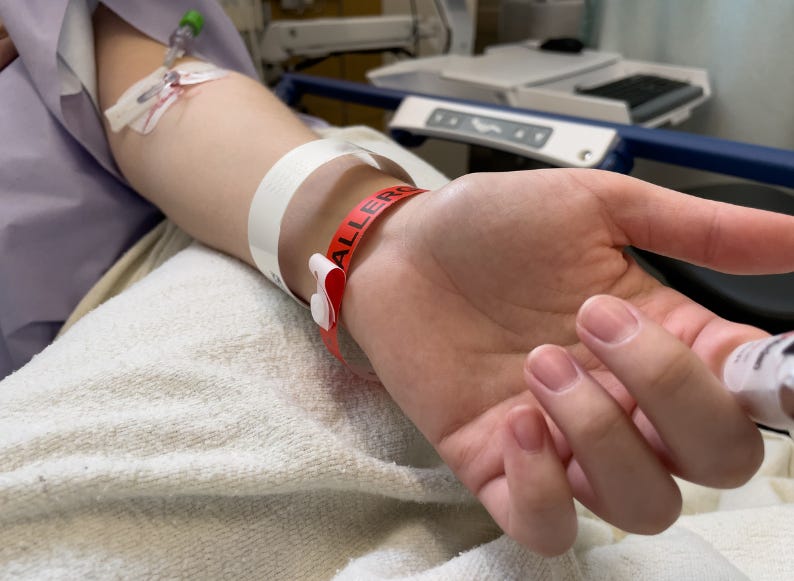
The hospital had a policy in place for exactly this kind of draw. Before any specimen intended for transfusion purposes could leave the floor, a registered nurse or physician was required to verify the patient’s identity and initial the label on the vial. It was a second check. A safeguard. The kind of redundancy that exists precisely because the stakes are high.
But it was the change of nursing shift. The patient’s bedside nurse wasn’t available. No physicians were on the floor. And the phlebotomist still had another entire floor of patients to see.
So she carried the labeled tubes out to the nurses’ station and had a random nurse — someone who had not seen the patient, had not verified his identity, and had no idea whose blood was in those vials — sign off on the labels. Then she sent the tubes to the lab.
The problem surfaced hours later, not because anyone at the bedside caught it, but because a lab technician noticed something strange. The hemoglobin result for a different patient on the same floor looked dramatically different from that patient’s value from the day before. That kind of delta — a sudden, unexplained shift in a result — is the kind of thing that makes a good lab tech stop and ask questions.
She dug into it. What she found was that all of the 54-year-old man’s tubes had been mislabeled with another patient’s label. The hemoglobin anomaly existed because the lab was looking at the wrong man’s blood and crediting it to the right man’s chart. And the type and crossmatch vial — the one that would have been used to match blood for his surgery — was also wrong.
The patient was redrawn in time. He went into surgery safely. No transfusion with mismatched blood occurred. But the only reason this ended without harm is that one lab technician’s instinct to follow up on a strange number. There was no system-level catch. No alarm. No second check that worked the way it was supposed to. Just one person deciding not to let a weird result slide.
That is a paper-thin margin.
Case Study #2: Four Failures in Four Weeks
The second case is actually a cluster of cases — four separate patient misidentification events reported to a large hospital’s patient safety committee within a single four-week window. This one was also published by AHRQ’s Patient Safety Network, and it’s the kind of report that’s uncomfortable to read because it doesn’t read like a story about careless people. It reads like a story about a system under pressure.
The event most relevant to our world involves two young men who arrived at the emergency department at overlapping times. One was 23, found unconscious outside a bar with facial injuries and bruising on his chest and abdomen. The other was 21, with facial injuries following a motor vehicle accident. Similar ages. Similar presentations. Neighboring rooms.
CT scans were ordered for both. When the results came back, they were charted under the wrong patients’ names — each man’s results appearing in the other’s chart. To make it worse, a CT of the abdomen and pelvis had been ordered only for the first patient, but it was performed on the second. A scan that wasn’t ordered for him, wasn’t needed for him, and exposed him to radiation without any clinical indication.
The error was eventually caught because the clinical team noticed the results didn’t match what they were seeing on physical exam. The imaging was re-done correctly and the records were fixed. But consider for a moment how different that outcome could have been. If the first patient’s abdomen scan had been missed because it appeared done — and he had internal bleeding — we would be talking about a very different case.
The other events in the same four-week period included a 68-year-old woman who received a contrast CT of the wrong body part because she shared a first name with another patient, and a 2-year-old girl who came out of surgery wearing an 8-month-old boy’s ID band. Four separate events. Four separate failures. One month.
The researchers who analyzed these cases identified the same root causes over and over: similar names, physical proximity of patients, high caseload, and failure to follow ID verification protocols at the point of care. These are not exotic problems. These are any old regular Tuesday.
What CLSI Standards Actually Require — And Why Every Detail Matters
CLSI standards for patient identification are not vague on this. The requirements are specific, and they are specific for a reason. A new version of this standard, CLSI PRE01 — Patient and Laboratory Specimen Identification Processes — is now available and continues to codify these requirements.)
Two unique identifiers are required before every draw. The standard combination is full name and date of birth — chosen specifically because patients can state them from memory, which is the whole point of the verbal confirmation. Not room number. Not bed tag. Those are not identifiers — they’re locations, and locations change. Patients get transferred. Charts get moved. A wristband hanging on a bedrail belongs to whoever is assigned that bed today, and today’s patient might not be the same as yesterday’s.
The patient must verbally state their information, and the phrasing matters more than most people realize. CLSI standards are explicit: you must ask open-ended questions that elicit specific information and cannot be answered with a simple yes or no. Ask the patient to state and spell their full name. Ask for their date of birth. You do not say “Are you John Smith?” and accept a nod. You do not read the name off the requisition and watch for confirmation. You do not show the patient the order and ask if it’s correct. A nod is not identification. A grunt is not identification. A patient who is confused, half-asleep, or simply agreeable will nod at almost anything — which means you have confirmed nothing.
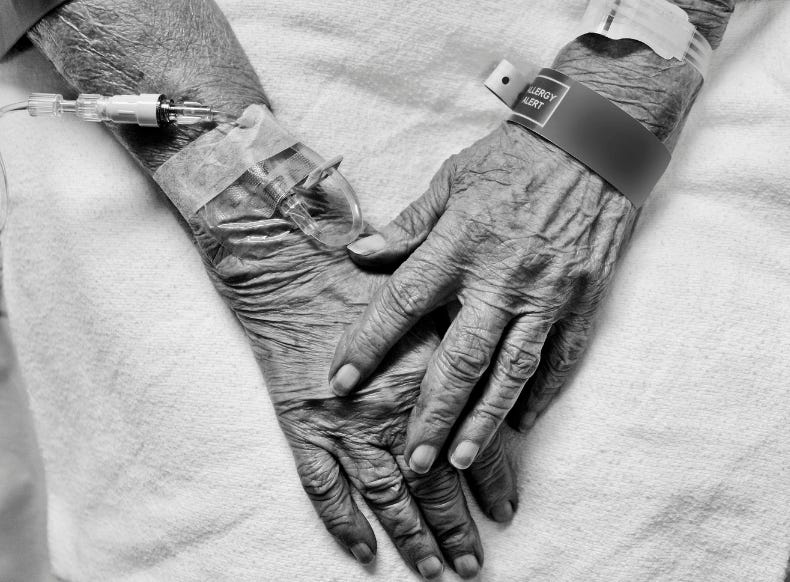
For inpatients, the wristband is a parallel check — not a substitute for the verbal confirmation. You still ask the patient to state and spell their name and give their date of birth. Then you cross-reference what they said against the wristband, which carries both the patient’s name and their patient-specific identifier (medical record number). All three must match: what the patient says, what’s on the band, and what’s on the order. And that wristband must be on the patient’s body. Not scanned from across the room. Not read off a bed rail or nearby table. CLSI standards are explicit that you must not rely on a bed tag, ID bands not attached to the patient, or charts or records placed on the bed, nearby tables, or equipment. If the wristband is missing, that is a stop point. You do not proceed until identification is established through proper channels.
For outpatients without a wristband, you ask the patient — or their guardian or caregiver if the patient cannot respond — to provide, not affirm, the same information. The standard is clear on this distinction: a family member or caregiver confirming a patient’s identity must provide the information independently, not simply agree with what you’ve already said. And for conscious patients who have a communication barrier, written identification is required.
When the draw is complete, only then do you apply the labels to the samples. Not before, and it needs to be at the bedside of the patient within their sight. Then you can ask them to once again verify that the labels now attached to the blood tubes are correct, and you can leave that patient with complete confidence that proper procedure was followed and the labeled samples belong to the correct patient.
And if there is any discrepancy between what the patient tells you and what appears on the order — however minor — you stop. You do not resolve it yourself. You do not make an assumption and proceed. You stop and you get it sorted out before a needle goes anywhere near that arm.
Look back at Case Study #1. The phlebotomist had already labeled the tubes. She knew there was a second-check policy. She chose to work around it because she was busy and the right person wasn’t available. And beyond the policy violation, she violated CLSI’s requirement that specimen containers be labeled immediately after collection, in the patient’s presence, by the health care professional who collected the specimen. Carrying tubes to a nurses’ station to get a random signature is the opposite of that. It was a shortcut layered on a shortcut.
It wasn’t fine.
The Bigger Picture
These two cases are educational near-misses. Nobody died (this time). But the consequences of a completed patient ID failure can be catastrophic and they have been. A mismatched type and crossmatch specimen can result in a patient receiving incompatible blood during surgery. ABO-incompatible transfusions trigger an acute hemolytic reaction — the immune system attacks the transfused red blood cells, releasing a cascade of toxic substances that can cause shock, kidney failure, and death. According to CLSI standards, 11% of all transfusion deaths are attributable to a failure to properly identify the patient or correctly label the tube. It is one of the most devastating outcomes in transfusion medicine, and it begins with a label.

The Joint Commission has identified patient misidentification as a leading cause of sentinel events — unexpected occurrences involving death or serious harm. Between 2014 and 2017 alone, 409 of the 3,326 sentinel events reviewed involved patient identification failures. Root cause analyses at Veterans Health Administration hospitals found that 72% of errors in the laboratory test cycle were traceable to patient misidentification. And those numbers reflect only what was reported and caught. CLSI standards note that 15% of patient identification errors go undiscovered entirely.
The Question That Changes Everything
I want to close with something I come back to every time I teach patient ID. When you walk into that room and you approach that patient, you are standing at the only point in the entire laboratory testing process where someone can look a human being in the face and ask questions. The lab can’t do it. The pathologist can’t do it. The physician reviewing results can’t do it. You are it.
That question — “Can you please state and spell your full name and tell me your date of birth?” — is not a formality. It is the entire defense. It is the moment where a mislabeled requisition gets caught, where a transferred patient gets identified correctly, where a confused elderly person gets a second look before a needle is placed. Every case I’ve described in this post had a moment — usually more than one — where that question, asked properly, would have stopped the chain.
Ask it every time. Ask it out loud. Ask it in a way that requires an answer, not a nod. And if something doesn’t match, stop.
The phlebotomist in Case Study #1 was probably a decent phlebotomist on any other morning. She was busy, she was running behind, and she made a judgment call that felt reasonable in the moment. I don’t think she was reckless. I think she was human. But that’s exactly why the standard exists — not for the easy days, but for the busy ones.
Related Posts and Information
overall rating: my rating: log in to rate
CLSI patient identification Phlebotomy sample labeling