
Hold Still, Sweet Pea: The Ethics and Reality of Restraining Children During a Blood Draw
Why Keeping a Child Safe Sometimes Means Keeping Them Still
by Shanise Keith • April 07, 2026
There is nothing quite like the moment a sweet doe-eyed toddler realizes what’s about to happen, and transforms into something that can only be described as a tiny, screaming, shockingly strong opponent. If you’ve drawn blood from children, you know exactly what I mean. And if you haven’t, let me paint you a picture — because what happens in the next few minutes matters more than most people realize, both for the child’s safety and for yours.
Restraining a child during a blood draw is one of those topics that makes people uncomfortable. It sounds harsh on the surface. Nobody wants to imagine a small child being held down. But I’ve spent years working with pediatric patients, and I’ll tell you plainly: an uncontrolled needle in a moving child is far more dangerous than a child who is safely, temporarily, and humanely held still. The discomfort of restraint lasts a few moments. A needle injury can last a lifetime.
Let’s talk about how it actually works — and how it should work — before we get into why this topic is more complicated than it looks.
Throughout my career, I have drawn blood from children of all ages, including babies freshly delivered just moments ago to the stubborn teenager about to turn eighteen. Toddlers are usually the worst; however, I have had extremely well-behaved, perfect-angel toddlers that required minimal help to hold them still, and I’ve had to have four people hold down a screaming seventeen-year-old — both on the same day sometimes. If you work with pediatrics, you experience this regularly.
The Parent in the Room
The first line of support for a pediatric blood draw is almost always the parent or caregiver. And this can go beautifully. A calm, confident parent who understands what you need from them, positions their child correctly, speaks softly and reassuringly, and holds steady when the child flinches is genuinely one of the most valuable tools in the room. I have had parents who were absolute naturals at this. The child calms just from being in their proximity. The parent listens and follows instructions you give to them. The draw goes smoothly. It’s great.
But I have also had the other kind. A parent who doesn’t even attempt to control their child. A parent who gets angry at you for having to do your job and draw blood from them. A parent who teaches their child to be afraid of you with their behavior or words. A parent who won’t help, and just makes things worse.
And yes — I have had parents hit the floor too. Watching your child get poked with a needle is a different experience than getting one yourself, and vasovagal responses don’t discriminate (it’s always the dads too). A parent who has just fainted is no longer a resource. They are now a second patient. I say this without any judgment whatsoever; it happens to caring, perfectly capable people. A parent on the floor is not the ideal outcome, but it points to the same truth: parental involvement during a pediatric draw can be valuable, and it is also unpredictable.
I was once tasked with drawing blood from a toddler, and I knew from my brief interaction with him that it was going to be a more difficult draw. I asked my coworker to come help me, gathered my supplies, and entered the room to explain to mom what we needed to do. I had a full step-by-step process for preparing a child for a blood draw so that it wasn’t so scary, and it was usually pretty successful when I could do it the way I needed to. One of those steps was to lay the child on the bed (which is usually where they already were). If the child tolerated a tourniquet and having a parent practice holding them down lightly before we got started, I typically went forward with the venipuncture with no further need for restraint. If the child became upset while we practiced some of these things, I would usually wrap them in a sheet and see how that went. If they were too strong for the sheet, we would break out the papoose board.
I already knew we might need the sheet for this little fellow. But as I explained to mom that he needed to lay down on the bed, she told me that her perfect little boy would hold still, and I would not need to restrain him. “He won’t move as long as he’s in my lap with his show on.”
I don’t know what kind of fairy-tale world mom lived in, because not twenty minutes before, that boy had thrown a screaming fit about the blood pressure cuff being on his arm, and we had barely been able to get a reading. I insisted that sitting up on the bed was not a secure way to hold him still, and she insisted that it was. We went back and forth, and she refused to lay him down, saying that we didn’t know her child like she did and that we needed to listen to her. We finally agreed to try it her way first, and if it didn’t work, we would do it my way the second time.

Mom sat on the bed, child in her lap. I showed her how to wrap her arms around him, with one of her legs pinning his legs down. She had her phone out with his show playing. My coworker securely held his right arm out for me to stick. I applied the tourniquet — so far, so good. As I was about to do the venipuncture, however, he managed to look over at the needle, and immediately lost it — screaming and twisting. My coworker had a good grip on his arm, and I did the puncture, hoping to end the procedure quickly. I was just getting blood into the first tube when he leaned his head forward and then smashed it backward into mom’s face, splitting her lip open. She immediately let go of him, and in the chaos, I had to stop the draw. It was over in about fifteen seconds.
For the second draw with that little boy, we used the papoose board. He screamed and thrashed, and I still needed someone to come hold the whole board down while my coworker helped hold his arm still — even with it strapped in. Mom watched from the side, holding ice on her rapidly swelling lip, disappointment and shock on her face. She was still in disbelief that her perfect child would behave in such a way.
The second stick we got the blood. We got it safely. And that was the last time I allowed a parent to talk me out of what I knew would be safest during a blood draw for their child.
Why You Need a Second Set of Hands
The draw with that little boy would have gone differently — and I mean that in every direction — without my coworker in the room. Even with mom losing control of the situation, my coworker maintained her grip on that arm. That mattered. It was the reason he didn’t get a serious injury, or that I didn’t accidentally stick myself. It was the reason I was able to perform the puncture at all before everything fell apart a few seconds later.
A good coworker changes everything. They can stabilize the arm you’re working on, leaving you free to focus on the vein and the draw. They can talk to the child, make eye contact, offer a distraction. They can hand you supplies without you having to turn away. And critically — they can watch the parent (look out for those fainters). This is how a pediatric blood draw should be staffed when the patient is young, anxious, or unpredictable. A coworker assist is not a luxury. It is a safety requirement. At least one coworker who knows the procedure, knows what to do when things aren’t going your way, and can help with the draws where it’s necessary.
Throughout all of it — parent holding, coworker assist, restraining the child, — distraction is running in parallel. Singing, talking, a toy, a phone video, whatever works for that child in that moment. Distraction is not a replacement for physical support; it is an adjunct. The two work together.
Types of Restraint
As I mentioned in the story above, beyond human restraint, there is a technique that doesn’t get mentioned enough: wrapping the child in a sheet or blanket, burrito-style, leaving only the arm you need exposed. It is simple, fast, and works remarkably well for smaller children who are flailing but not yet at full toddler-strength revolt. The pressure of the wrap can actually be calming for some kids, similar in principle to swaddling an infant. I have used this more times than I can count, and it has saved more than a few draws that might otherwise have escalated. It looks less scary than a papoose board, and parents don’t usually have an issue with this type of restraint.
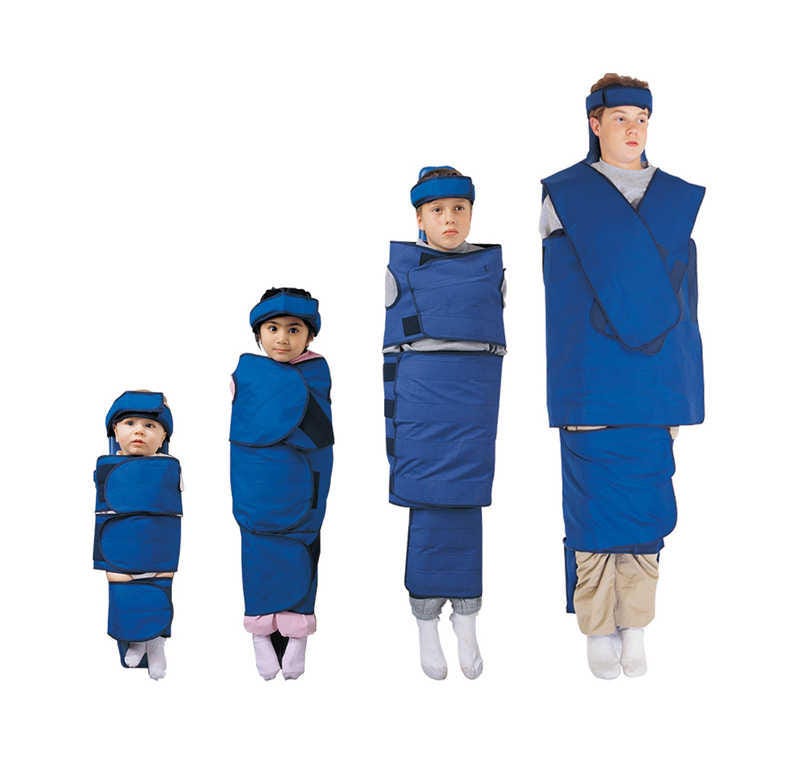
The papoose board is a cushioned board fitted with Velcro straps that temporarily immobilizes a patient’s body during a procedure. The name comes from traditional Native American infant carriers, a comparison that is, frankly, a poor fit for what this device actually does. It looks alarming to people who haven’t seen it used correctly. I understand why. Strapping a screaming child to a board is not a gentle image. I won’t pretend otherwise. It’s traumatic for kids. There’s no way around it. The sheet is one thing, but the sound of the velcro, and being strapped to a board is a level above. No one enjoys having to use it, but this is a lesser of two evils type of choice. I am glad that it was an option available to me when it was needed though.
Papoose boards come in sizes that accommodate patients well beyond toddlerhood — because the need to hold still during a venipuncture doesn't always align with a patient's ability to do so, regardless of age. For patients with cognitive or developmental disabilities, the board can be one of the most dignified options available, allowing the procedure to be completed quickly and safely without a prolonged physical struggle.
Here is what I know from practice: there is a subset of children — particularly toddlers with the strength-to-size ratio of a small bear — for whom no human arrangement of arms and hands is going to create a safe needle environment. When a child is thrashing with full-body force and a needle is involved, something has to give. The question is whether it will be the restraint method or the integrity of the venipuncture site. A brachial artery injury, a hematoma that compresses a nerve, damaged muscle or other tissue — these are the outcomes of an uncontrolled stick.
The papoose board, used appropriately, with consent, and after other methods have been considered or attempted, is safer than those alternatives. And the thing about injuries with kids who are non-verbal, or toddler-age and younger is that they don’t have the words or ability to tell us what hurts. They will scream and cry during a blood draw, and if we strike a nerve we won’t be able to tell. They will just continue to scream. I would much rather traumatize them for a few minutes by holding them down, than risk causing an injury.
The Ethics Debate: UK vs. the US
This is where the international conversation gets interesting. In the United Kingdom, within dentistry specifically, the papoose board has been prohibited on the grounds that behavioral and anxiety-reduction techniques should always be exhausted first. Any restraint used on a child must be necessary, proportionate, and the least restrictive option available. The American Academy of Pediatric Dentistry takes a more pragmatic stance, supporting the use of stabilization devices when they are necessary to protect the patient, the practitioner, and the staff from injury. Colorado, interestingly, landed somewhere in the middle after a dental chain in the US was found to have used the board nearly 7,000 times in eighteen months — not for safety, but for efficiency. Colorado now requires documented evidence that all other options were exhausted before the board is used.
That abuse is exactly why the device has such a bad reputation, and it is a reputation that was earned in those cases. The papoose board used as a shortcut to move patients through faster, without consent, without attempting anything else first — that is indefensible. But that is not what I’m describing, and it is not what responsible practitioners do. What happened in that exam room with my little patient and his injured mother was the opposite of a shortcut. The board was the last option, not the first, and if we had been allowed to go through the process normally I don’t think a papoose board would have been needed. Likely just being held down on the bed would have sufficed, and if we had needed to, then a sheet would have done the job.

What the World Health Organization says, for its part, is that immobilization is crucial to the safety of a pediatric patient undergoing phlebotomy, and that designating one person as the technician and another to immobilize the child is simply best practice. The WHO doesn’t treat restraint as a last resort. It treats it as a standard component of doing the job safely.
Where I Land
My hierarchy looked something like this: meeting the child and explaining the procedure in friendly terms they could understand so I could learn their demeanor and prepare them. Then, during the draw, distraction, always. Then parent support, with a coworker present. Next, safe positioning — always supine position on a bed for toddlers and younger. Then a sheet wrap if more containment was needed. Then, and only after all of that had been genuinely tried, the papoose board — with parent consent explained clearly, and with the goal of getting in and out as quickly and calmly as possible.
The ethics of restraining a child are real, and they deserve to be taken seriously. A child’s dignity, their fear, and the potential for a traumatic memory are all legitimate concerns. But so is a needle moving through tissue it was never meant to enter. So is a phlebotomist trying to maintain control of a draw that has gone sideways. So is the parent who needs their child’s lab results so a physician can make a decision about that child’s health.
Safety is not the enemy of compassion. Done right, restraint is compassion — for the child who needs the procedure completed quickly and without injury, for the parent who needs to know their child is protected, and for the phlebotomist who bears responsibility for what happens at the end of that needle. The goal has never been to punish a scared toddler. It has always been to get them through something necessary, and get them home.
Related Posts and Information
overall rating: my rating: log in to rate