
Gone in 60 Seconds: Your Specimen's Point of No Return
Tourniquet Time, Tourniquet Types, and What to Do When One Minute Isn't Enough
by Shanise Keith • May 19, 2026
If you read our last post on the history of the venipuncture tourniquet, you know the strip on your cart has a surprisingly long and winding lineage. But history only gets us so far. The more pressing question for working phlebotomists is practical: how does the tourniquet affect your specimen, how long is too long, what kind should you be using, and what do you do when the draw is too complex to complete in sixty seconds?
Let’s get into it.
What the Tourniquet Is Actually Doing
When you apply a tourniquet, you’re partially occluding venous outflow from the arm while arterial inflow continues. Blood pools in the vein below the tourniquet, pressure builds, and the vessel distends — making it visible, palpable, and accessible. That’s the goal, and in the first sixty seconds or so, it’s all the tourniquet is doing.
The problem starts quietly, in the tissue surrounding the vein. As venous pressure rises, plasma begins to be forced out of the capillary beds and into the surrounding interstitial tissue. The blood remaining in the vein becomes progressively more concentrated — not because anything new entered the vein, but because fluid left. Think of it like reducing a sauce on the stove: you’re not adding anything, you’re just driving off water. What remains is thicker and more concentrated than what you started with. It makes for a delicious soup. It does not make for accurate test results. This is hemoconcentration, and it’s the mechanism behind nearly every pre-analytical error the tourniquet causes.
What Happens Past Sixty Seconds
CLSI PRE02 is unambiguous: the tourniquet should not remain in place for longer than one minute. That guideline isn’t arbitrary. It reflects the point at which hemoconcentration begins producing clinically meaningful changes in specimen composition.
Here’s what the research shows happens when that one-minute window closes:
Total protein, cholesterol, and calcium all increase as plasma water shifts into surrounding tissue. Because these analytes are large or protein-bound, they concentrate faster than smaller freely diffusible molecules.
Hemolysis risk climbs steeply. One study found the odds ratio for hemolysis when tourniquet time exceeded one minute was 19.5 — nearly twenty times the baseline risk. Hemolyzed specimens mean repeat draws, patient inconvenience, and delayed results.
Potassium is particularly vulnerable through two compounding pathways. Hemoconcentration elevates the potassium already present in plasma as fluid shifts out of the vascular space. More dramatically, hemolysis — which is nearly twenty times more likely when the tourniquet exceeds one minute — causes red blood cells to rupture and release their intracellular potassium directly into the specimen. The potassium concentration inside a red blood cell runs around 105 mmol/L — roughly 25 times higher than the normal plasma value of about 4 mmol/L — so when cells start rupturing, even modest hemolysis sends a significant potassium load flooding into the specimen. The result can push a normal result into the range that triggers a cardiology consult — for a patient whose potassium is completely fine.
Other affected analytes include iron, bilirubin, AST, and various enzymes that are sensitive to cellular disruption or hemoconcentration.
The longer the tourniquet stays on, the worse these effects become — and importantly, they don’t reverse the moment you release it. Once hemoconcentration has occurred in the vein, the blood in your tubes reflects that altered state. CLSI recommends that if a tourniquet has been applied for longer than one minute during vein assessment, it should be released and the arm allowed to equilibrate for at least two minutes before reapplication.
In real-world practice, this guideline is widely ignored. One study measured average tourniquet application time before a training intervention and found the mean was 118 seconds — nearly two minutes. Every lab, every day, potassium values are being read by clinicians who don’t know the tourniquet was on for two minutes or more.
Types of Tourniquets
Not all tourniquets are created equal, and phlebotomists working across different settings will encounter several varieties.
The flat disposable strip is the current standard of care and the type CLSI recommends. These are single-use, latex-free, and designed to be discarded after each patient. They’re fast to apply, easy to release with one hand, and cheap enough that there’s no legitimate reason to reuse them. This is what should be on your cart.
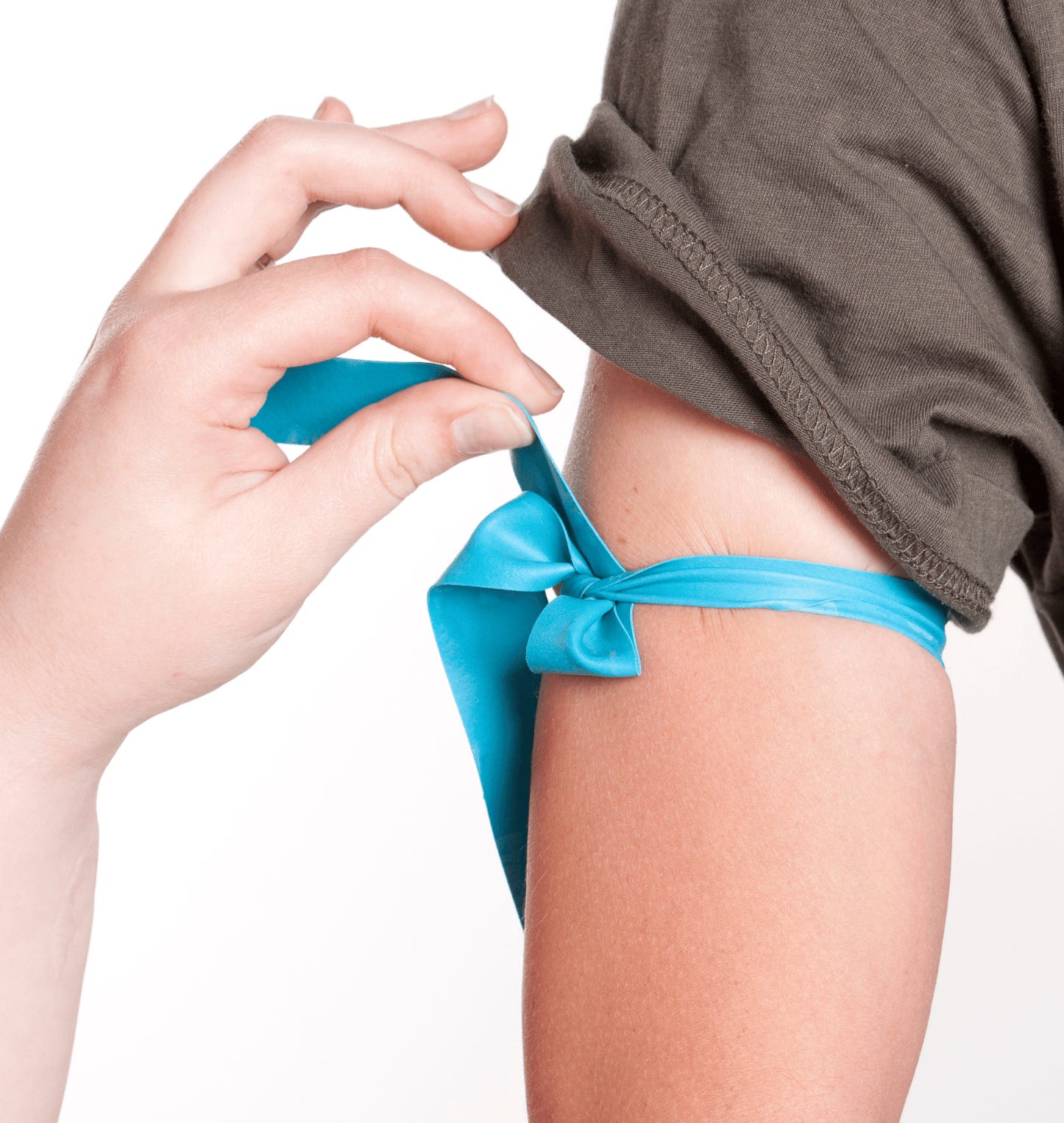
The Tournistrip is a newer single-use option worth knowing about. Made by ASep Healthcare, it’s designed to look and operate like a conventional tourniquet but with a few practical advantages. It won’t roll the way a flat rubber strip can, it’s easy to tension and adjust without tying, and single-handed release is built into the design. It can also be repositioned on the same patient up to five times without compromising the single-use principle. I’ve tested it and it works well — if you’re looking for alternatives to your basic disposable strip, it’s worth a look.

The fabric or Velcro tourniquet is reusable by design — a woven band with a hook-and-loop closure. These are comfortable for patients and easy to adjust, and they were popular for years. They’re also a contamination problem. The fabric weave harbors bacteria in a way that smooth disposable strips don’t, and they’re difficult to adequately disinfect between patients. If you’re still seeing these in your facility, that’s worth a conversation with infection control.
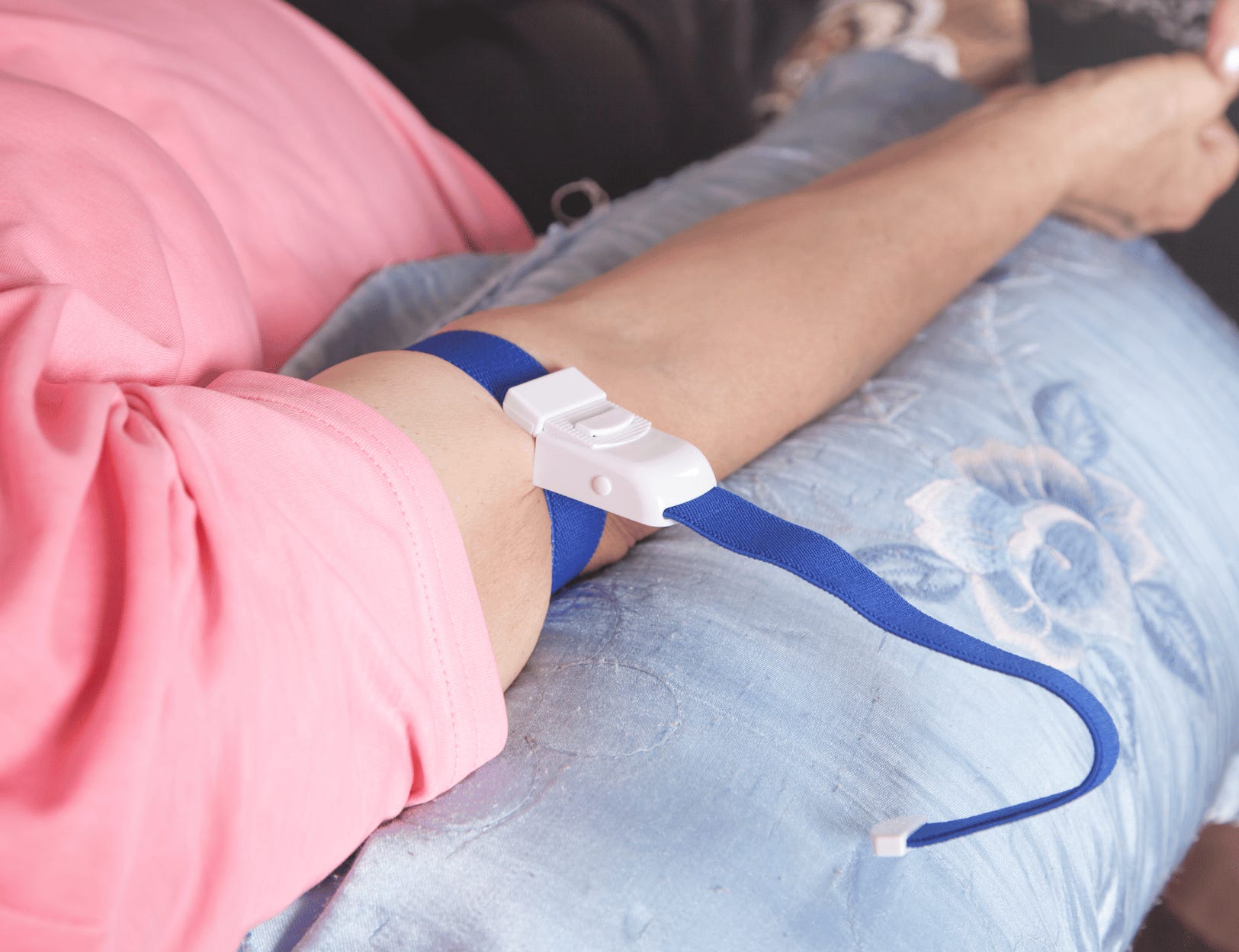
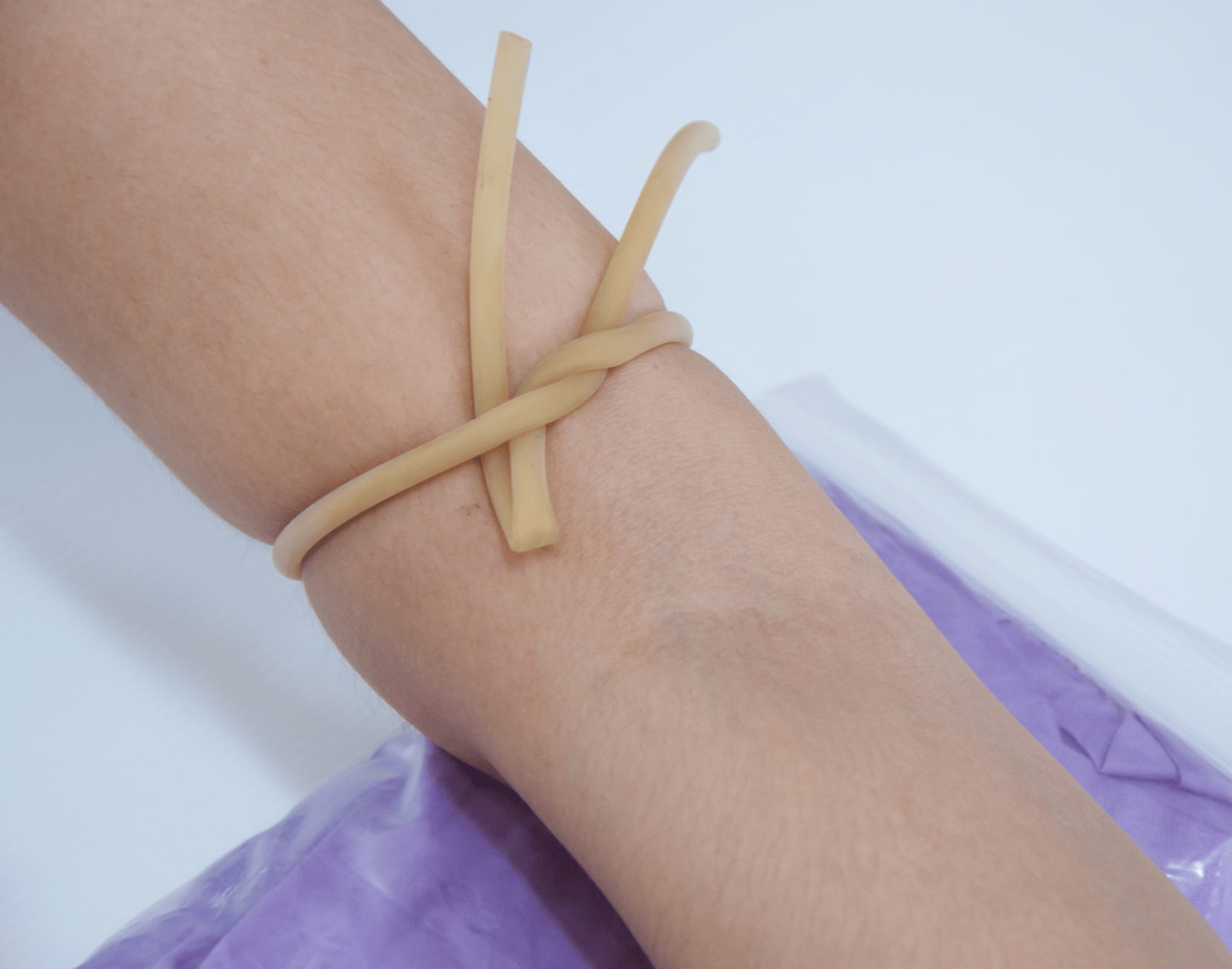
The rubber tube tourniquet — a length of latex or rubber tubing tied in a slipknot — is the historical predecessor to the modern strip and still turns up in some settings. Same contamination concerns as any other type, with the added problem that latex tubing poses a risk to patients with latex allergies. These should be retired, we have better alternatives now.
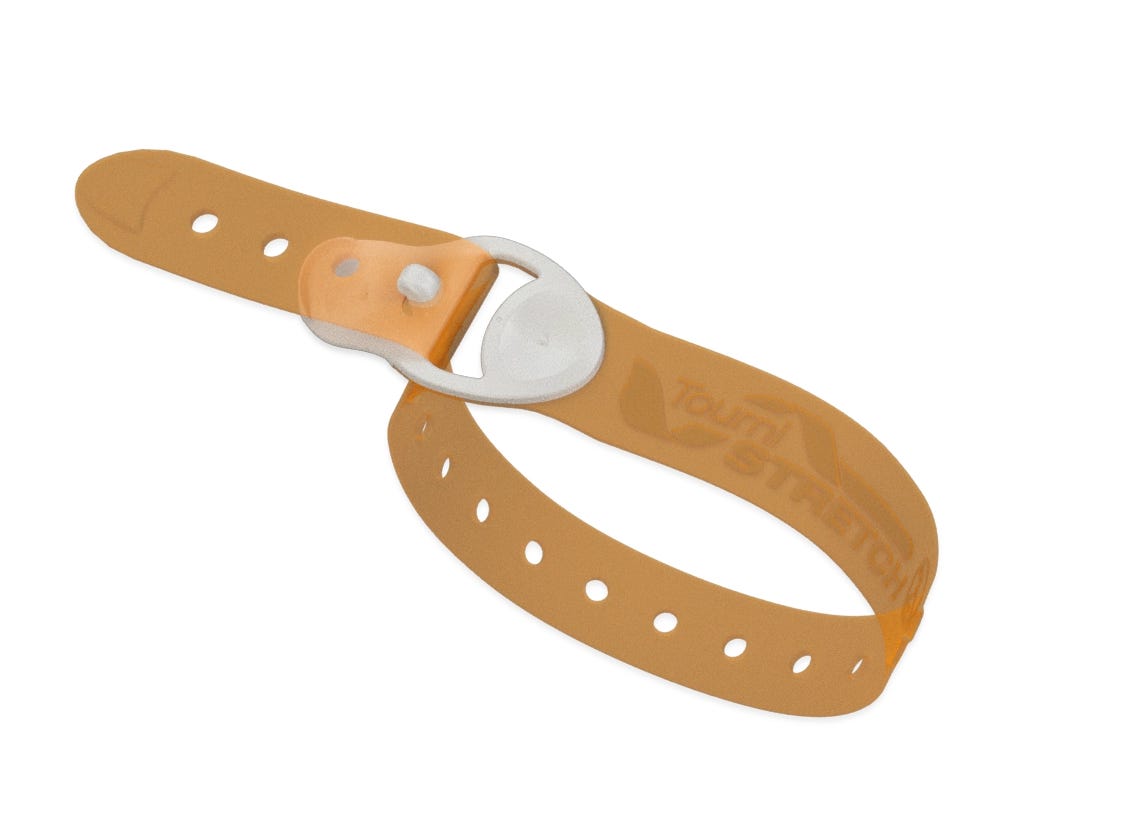
The tab-and-slot tourniquet — the older style with punched holes along the band that hook onto a small plastic clasp — was a step toward standardization but shares the reusability problem of the fabric type. These are often reused over and over. If you recognize this one, it’s had a long run. Its time is up. It is worth noting that there are some of these that are made to be single use such as this one also made by Asep Healthcare.
The blood pressure cuff is in its own category and gets its own section below, because its appropriate use goes beyond simple vein distension.
The Contamination Problem
The case for single-use tourniquets isn’t just about convenience. It’s about patient safety, and the research is uncomfortable reading.
A study published in the Journal of Hospital Infection gave phlebotomists a fresh, sterile tourniquet at the start of each working day. By the end of that day — after a normal volume of draws across multiple patients — 25% of those tourniquets were contaminated with MRSA. Not after weeks of reuse. After one day.
A separate cross-sectional study of 200 tourniquets in a tertiary care hospital found MRSA contamination in 26% of collected tourniquets, with rates varying significantly by ward. A 2023 systematic review confirmed MRSA as the most commonly found organism, turning up on 12% of all tourniquets tested across the studies reviewed.
The mechanism isn’t mysterious. A tourniquet is pressed against patient skin, handled by the phlebotomist’s gloved and ungloved hands, set down on surfaces, and stuffed into pockets or supply pouches — often repeatedly, between patients who may include MRSA-positive individuals in non-isolated settings. Disinfecting a reusable tourniquet between every patient in a high-volume draw environment is theoretically possible but practically rare, and likely to be done inefficiently due to time constraints.
WHO guidelines on best practices in phlebotomy recommend single-use devices for blood collection. CLSI echoes this. The disposable strip is not a luxury. It is the standard.
The Multi-Tube Problem
Here’s a scenario every experienced phlebotomist has faced: the order is for twelve tubes. The patient has one usable vein. You know before you apply the tourniquet that you will not complete this draw in sixty seconds. A good, cooperative vein can yield a lot of tubes in a well-executed draw — but double digits is a significant ask. The math simply doesn’t work: by the time you’re applying tube seven or eight, you’re well past the one-minute mark, and you’re collecting hemoconcentrated blood whether you acknowledge it or not. The longer the tourniquet has been on, the more compromised every subsequent tube becomes.
High tube counts aren’t the only situation where the clock becomes a problem. Sometimes draws are simply slower than anticipated. A butterfly to the dorsal hand can fill tubes so slowly that even four tubes can’t be completed within the one-minute window. And when you do release the tourniquet around the minute mark, tubes that were filling steadily can slow to a trickle — leaving you with a decision to make about whether to wait, reapply, or call it and come back with a second stick. In those cases, the calculus is the same regardless of how many tubes are on the order: a second stick is safer and more accurate than leaving the tourniquet on and hoping for the best.
There are a few legitimate strategies for managing this situation.
Release and reapply. If you’ve been in the vein for close to a minute and have tubes remaining, release the tourniquet, keep the needle secure, and wait two minutes before reapplying. Fill what tubes you can while the tourniquet is off. Yes, this adds time. Yes, it requires the patient to hold still. It’s still better than the alternative, which is delivering a potassium of 6.2 to a clinician who doesn’t know why. In practice, this technique requires a butterfly needle taped securely in place — you’ll need both hands free to reapply the tourniquet. This also aligns with CLSI’s requirement that all needles be secured for the duration of every blood draw, either by holding them or taping them in place.
Consider a second stick. Sometimes the right answer is to complete what you can safely within the first minute, withdraw, allow equilibration, and perform a second venipuncture for the remaining tubes. This is a harder conversation to have with a patient who just got stuck once, but it is safer and more accurate than completing a twelve-tube draw on a tourniquet that’s been on for four minutes. Patient safety and result integrity are the standard, not convenience.
Use a blood pressure cuff. This is my favorite, and the most effective strategy for high-volume draws or patients with difficult access, and it’s supported by CLSI standards.
The Blood Pressure Cuff as Tourniquet
When a conventional tourniquet isn’t sufficient — or when the draw volume makes the one-minute rule impossible to respect — a blood pressure cuff is a legitimate and well-documented alternative.
The principle is the same as the standard tourniquet: partial venous occlusion to distend the vein. The advantage is precision. Rather than applying unknown compression with a rubber strip, you inflate the cuff to just below the patient’s diastolic blood pressure — typically around 70 or 80 mmHg for a normotensive patient — which is sufficient to impede venous outflow without occluding arterial inflow. Earlier versions of the CLSI standard recommended a flat 40 mmHg, but the standard was revised when it became clear that 40 mmHg was insufficient for hypertensive patients and potentially excessive for pediatric and geriatric patients. Inflating just below diastolic accounts for individual variation.

The practical advantages are real:
- The cuff can be inflated for one minute, fully deflated, and reinflated after a two-minute rest — allowing you to work through a high-tube-count draw in controlled, compliant intervals.
- It can be applied and then operated with one hand once positioned, which is a meaningful ergonomic benefit during complex draws.
- Many modern automated blood pressure machines include a dedicated tourniquet setting specifically for this purpose, removing the need to manually monitor pressure.
The caveat is that using a blood pressure cuff as a tourniquet requires the phlebotomist to know the patient’s diastolic blood pressure. That means taking a blood pressure reading before the draw, or confirming a recent reliable value from the chart. A phlebotomist who cannot take a blood pressure cannot safely use this technique — inflating blindly to a fixed number reintroduces the same one-size-fits-all problem the standard revision was designed to solve.
The Bottom Line
The tourniquet is the most casually handled tool in the phlebotomy setup, and it is often one that causes the most silent pre-analytical damage. One minute is not a suggestion. Single-use is not optional. And when the draw is too complex for sixty seconds, the answer is a deliberate strategy — not optimism about how fast you can fill tubes.
The patient whose potassium comes back falsely elevated will be chased down for a repeat. The patient whose specimen hemolyzes will be stuck again. The patient on the wrong ward who picks up MRSA from a tourniquet that’s been in someone’s tray for a week — that’s a different kind of problem entirely.
Use the right tourniquet. Use it once. Watch the clock.
Related Posts and Information
overall rating: my rating: log in to rate
hemoconcentration hemolysis potassium preanalytical tourniquet