
The Tool That Needed No Inventor
The history of the phlebotomy tourniquet
by Shanise Keith • May 12, 2026
There’s a small strip of rubber sitting in a drawer at every phlebotomy station in the country. We stretch it, snap it onto an arm, wait a beat, and barely think about it. It’s a fairly unremarkable tool in our kit.
But that strip has a history that runs through ancient Roman amputations, medieval barbershops, Civil War surgery tents, and early 20th-century hospital wards. And the core idea behind it — the reason it works at all — was never formally discovered. No paper announced it. No inventor named it. Because it didn’t need to be discovered. It needed to be noticed.
Most of us learned it as children. Wrap a rubber band around a finger and watch it turn purple. Wear a tight hair tie against your wrist and see the veins on the back of your hand rise to the surface. Tie a piece of yarn around your arm on a dare and feel your fingers go numb. Every kid who has ever done any of these things has independently stumbled onto the same physiological principle that barber-surgeons were exploiting in medieval Europe: partial constriction of a limb traps venous blood and brings veins to the surface. It is one of the most intuitive observations in the history of medicine, which is probably why no one thought to write it down as a discovery. It was just something that was true — obvious once seen, impossible to unsee.
What changed over time wasn’t the understanding. It was the context in which that understanding was applied. The knowledge was codified gradually in clinical manuals as assumed practice, accumulating the way a lot of practical knowledge does: through hands dirty with the work, generation after generation. The specific device in your drawer did eventually earn a patent — but not until 1991. For everything that came before it, there was just the observation, and the ingenuity to put it to use.
It’s worth tracing that arc.
The Barber-Surgeon’s Discovery
If you want to find the true ancestor of the venipuncture tourniquet, you don’t start on a battlefield. You start in a barbershop.
From roughly the 5th through the 19th centuries, the dominant practitioners of bloodletting weren’t physicians — they were barber-surgeons. The medical establishment of the day considered surgery beneath them, so the work fell to barbers, who already handled sharp implements and had the temperament for it. By 1163, a church edict had formalized the arrangement, limiting monks to the care of souls and handing bloodletting and dentistry to the barber-surgeons. They developed a thriving, guild-organized trade that lasted for centuries.
Their primary tool for venesection was the fleam or lancet — a small, sharp blade used to nick a vein and let blood flow. The goal was volume. Patients were bled until they felt faint, sometimes until they actually fainted, in the belief that restoring humoral balance required removing substantial quantities of blood. For a procedure that depended entirely on getting a vein open and flowing, finding and accessing that vein was everything.
And here’s where we can first trace the practice: barber-surgeons learned, empirically, that wrapping a band or ligature around the arm above the site made veins swell and become easier to target with the lancet. Whether this was formalized as a technique or passed down as shop-floor knowledge isn’t entirely clear — the historical record is spotty, as you might expect from a guild of artisans rather than university physicians. But references to tourniquet-like bandages being used in venesection appear in early medical texts, with at least one noting that a ligature applied too close to the site could actually interfere with proper vein filling — evidence that practitioners understood the mechanics well enough to identify when they were doing it wrong.
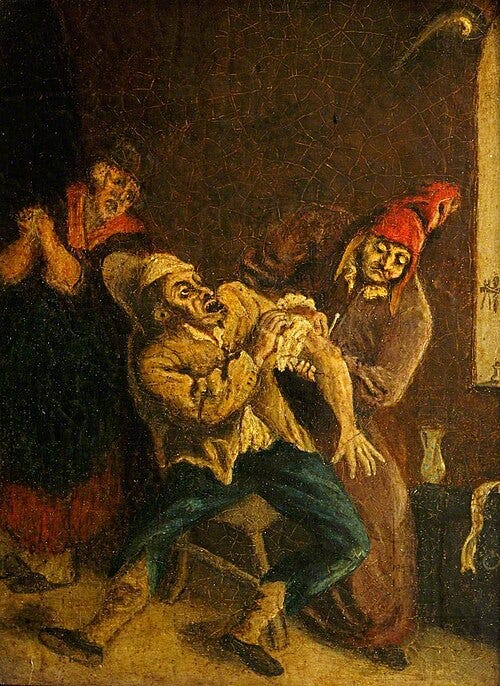
There’s another detail from the barber-surgeon era that belongs in this conversation: the barber’s pole. Patients undergoing bloodletting were given a wooden rod to grip during the procedure. Squeezing the rod caused the forearm muscles to contract, pushing blood into the veins and making them bulge — the same reason we may ask patients to make and hold a fist today (remember, no fist pumping allowed). The barber’s distinctive red-and-white pole isn’t just a decoration. The red represents blood, the white represents the bandages used in the procedure, and the pole itself was the device patients gripped to raise their veins. Every time you walk past a barbershop, you’re looking at a 700-year-old phlebotomy instruction.
A Brief Detour: The Other Tourniquet
This is also the point where we should acknowledge the tourniquet most people think of — the surgical and trauma variety — because it shares a name with what’s on your cart but is otherwise a different device doing a different job.
The concept dates to ancient Rome, where soldiers used narrow bronze straps to stanch hemorrhage during battlefield amputations. It was brutal, practical, and effective enough that the basic design went largely unchanged for centuries — a band around a limb, twisted tight with a stick until the bleeding stopped. The Romans didn’t have a name for it. That came later.

The word tourniquet was coined in 1718 by French surgeon Jean-Louis Petit, from the French tourner — to turn — describing the stick used to twist a constricting band tight enough to stop arterial bleeding. Petit’s screw device formalized centuries of battlefield improvisation into a controlled, releasable mechanism, and the name stuck. By the time diagnostic venipuncture became standard practice in the early 20th century, “tourniquet” was already the established medical vocabulary for any constricting band applied to a limb. The word simply carried over — nobody sat down and named the rubber tubing phlebotomists were using. It was already called a tourniquet because that’s what you called things that wrapped around limbs and restricted blood flow.
The surgical tourniquet evolved significantly from Petit’s design — through Lister’s use of it to create bloodless operative fields in 1864, Esmarch’s rubber exsanguination bandage in 1873, and Harvey Cushing’s pneumatic cuff in 1904, which finally allowed precise, controllable pressure. That pneumatic cuff is the ancestor of the surgical tourniquet still used in operating rooms today, and it was engineered to do something the phlebotomy tourniquet specifically must not do: completely occlude arterial inflow and stop all blood movement. The venipuncture tourniquet works on an entirely different principle — partial venous occlusion while arterial flow continues, which is exactly what causes the vein to distend. Two devices, one name, opposite physiological goals.
Rubber Tubing and the Diagnostic Revolution
The bridge between the barber-surgeon’s bandage and the modern phlebotomy tourniquet runs through the early 20th century, when diagnostic blood testing transformed from a novelty into a cornerstone of clinical medicine.
By the turn of the century, clinical laboratories existed, but they were small and their role was limited. That changed rapidly. In 1908, Todd and Sanford published Diagnosis by Laboratory Methods, one of the first manuals to document formal venipuncture technique for diagnostic purposes. By the 1920s, diagnostic venipuncture had become widespread, and a new kind of practitioner — neither surgeon nor barber — was routinely drawing blood from patients who weren’t sick enough to be hospitalized, simply to run tests.
Those early practitioners needed a way to distend veins, and they used what was available: rubber tubing. A short length tied around the arm in a slipknot, snug enough to impede venous outflow without stopping arterial inflow, was the standard venipuncture tourniquet for decades. Penrose drains — flat rubber tubing designed as surgical wound drains — were so commonly pressed into service as tourniquets that some institutions stocked them specifically for the purpose. There was no purpose-built phlebotomy tourniquet. There was just rubber, and the knowledge, passed down from barber-surgeons through centuries of practice, that wrapping something around a limb made veins come up.
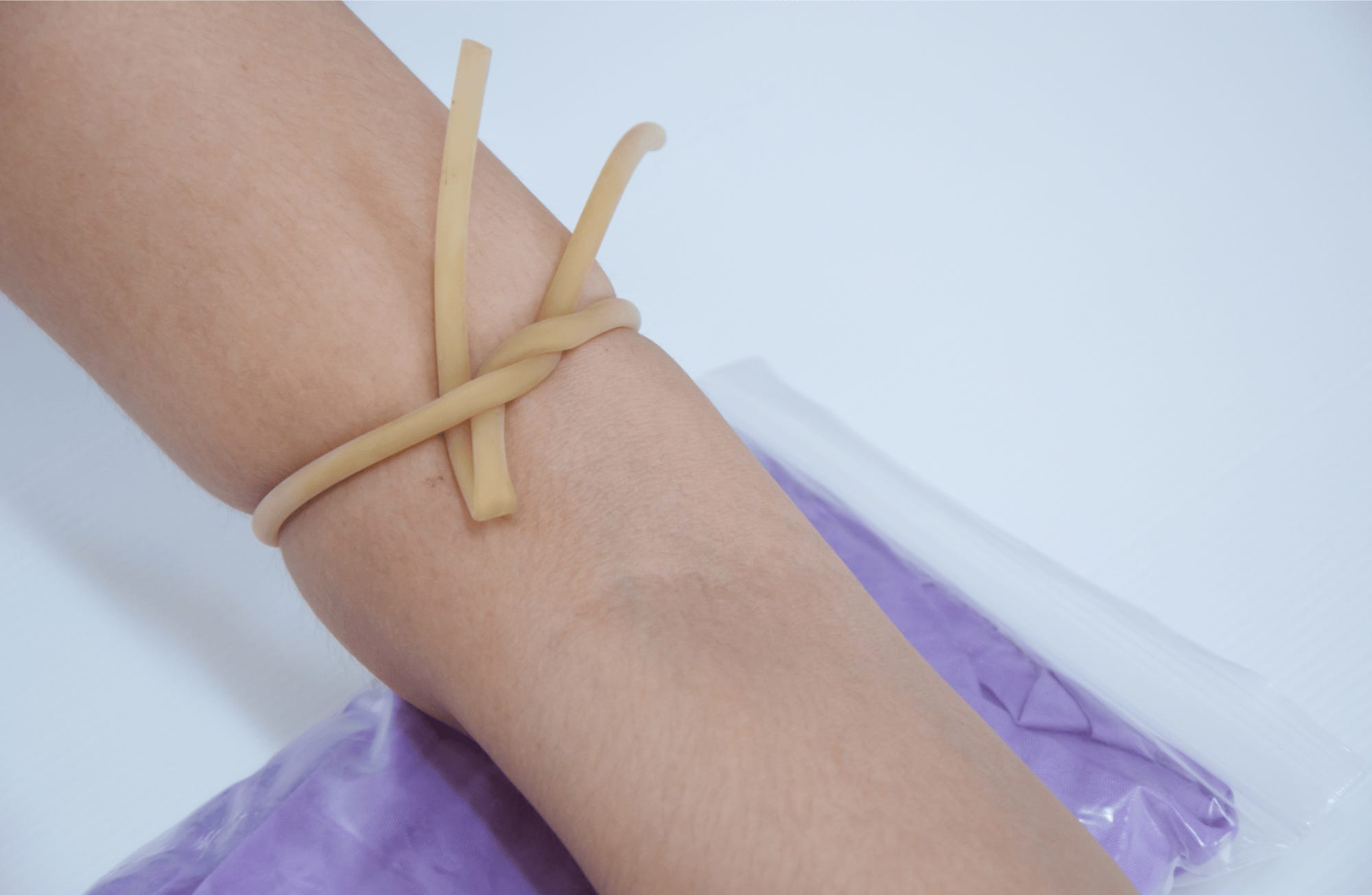
That changed on December 23, 1991, when four inventors at a company called Ingress Technologies filed a patent for the first purpose-built disposable phlebotomy tourniquet — US Patent 5540714, granted in 1996. The device was a single-use strip of coated elastic fabric, and the patent text is remarkably candid about what it was replacing: “a length of rubber tubing or strapping is commonly used for this purpose.” After roughly seventy years of rubber tubing doing an adequate job, someone finally designed something better.
What drove the invention wasn’t a new understanding of vein physiology. It was fear. The patent was filed at the height of the AIDS epidemic’s transformation of clinical practice, in the same cultural moment that made disposable syringes, single-use needles, and latex gloves mandatory. Reusable rubber tourniquets — handled by every clinician, stretched across patient after patient, rarely cleaned — were a quiet infection control problem. The disposable phlebotomy tourniquet was the solution, born not from curiosity about veins but from the urgent need to stop passing blood-borne disease between patients.
Latex allergy recognition in the late 1970s and an FDA latex labeling requirement in 1998 pushed manufacturers further toward non-latex alternatives. The patent itself expired in 2013. The reusable tourniquet that lived in a clinician’s coat pocket for weeks or months — studies found some had been in continuous use for nearly two years, with contamination rates for MRSA documented in the research — gave way to the bright-colored single-use strips that stock every draw station today.
What took even longer to sort out was how long the tourniquet should actually stay on. The device itself was refined over decades, but the question of what it was doing to the specimen in the meantime went largely unasked. That reckoning came later.
What Happens After Sixty Seconds
The moment you apply a tourniquet, a clock starts running. In the first minute or so, the effects on your specimen are minimal and generally acceptable. After one minute, hemoconcentration begins.
Hemoconcentration happens because the tourniquet doesn’t stop everything — it impedes venous outflow, but arterial pressure continues pushing plasma out of capillary beds and into surrounding tissue. What’s left behind in the vein becomes progressively more concentrated. Proteins, cells, large molecules, and analytes that bind to proteins all rise relative to their true values. Studies have documented statistically significant increases in serum potassium, total protein, cholesterol, and calcium after even one minute of tourniquet application. And hemolysis risk climbs steeply: one study found the odds ratio for hemolysis when tourniquet time exceeded one minute was 19.5 — nearly twenty times the baseline risk.
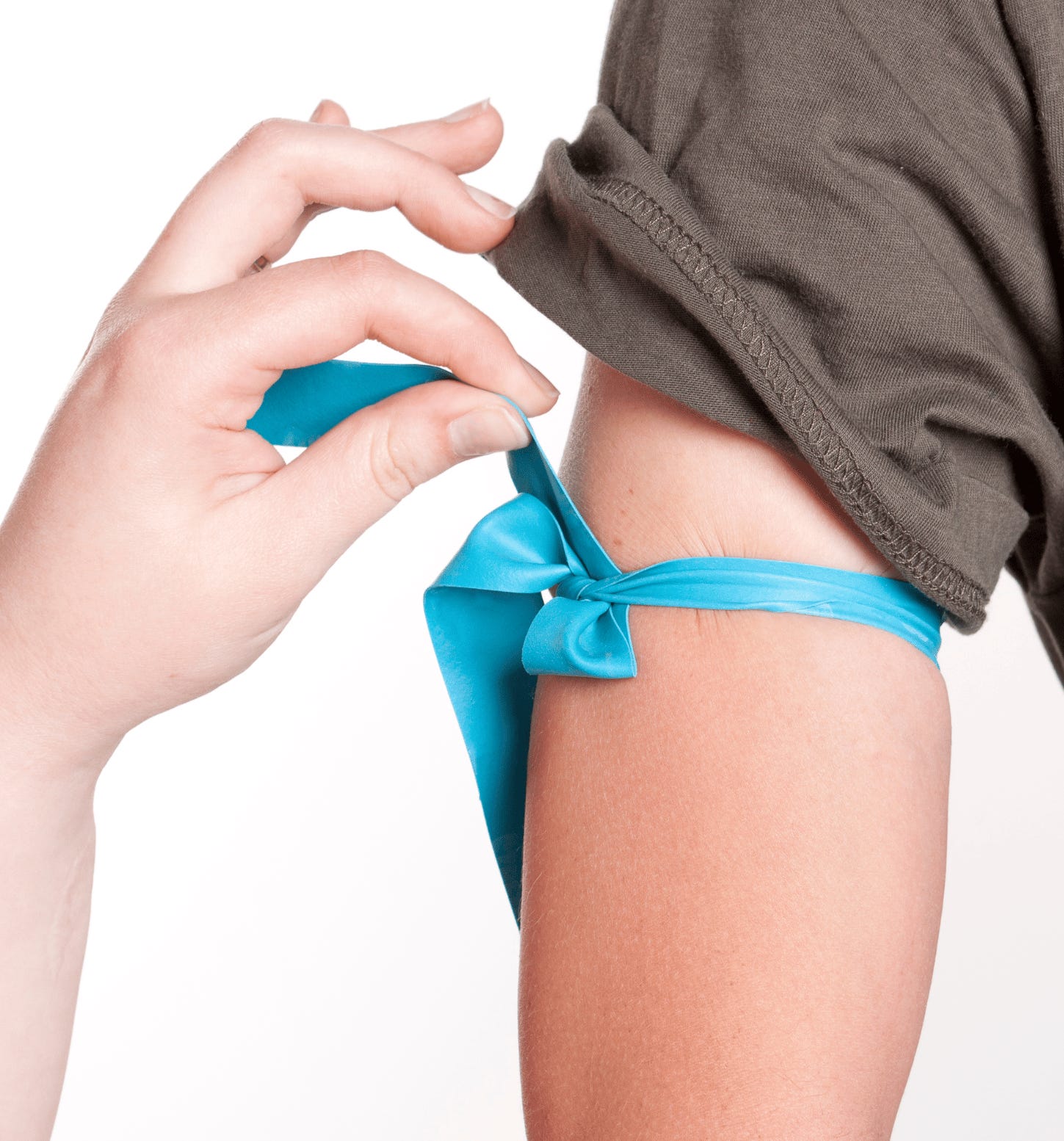
CLSI recognized this and addressed it in GP41: apply the tourniquet, complete your vein assessment, and draw within one minute. If a suitable site hasn’t been found in sixty seconds, release the tourniquet and wait at least two minutes before reapplying, allowing the concentrated blood to equilibrate back to baseline.
The problem is that this guideline is widely disregarded in practice — not out of malice, but out of habit and time pressure. One study measured average tourniquet application time before a training intervention and found the mean was 118 seconds. Nearly two minutes. Every day, in labs across the country, clinicians are reading potassium values that were elevated before the blood ever left the arm.
There will be another post in the future that discusses all this in more detail. Stay tuned.
The Tool That Forgot Its Own History
The barber-surgeons who wrapped bandages around arms in medieval barbershops and the phlebotomists snapping on rubber strips in a modern hospital draw room are doing something recognizably similar, for a recognizably similar reason. They both learned — through experience, observation, and accumulated practice — that partial constriction of a limb brings veins to the surface. No controlled trial established this. No inventor named it. It is one of the oldest techniques in our professional lineage, and it arrived in our hands without a timestamp.
What we did add, eventually, was the science: the understanding of why it works, what it does to the specimen, and exactly how long we have before the tool that helps us find the vein starts quietly corrupting what we collect from it.
The barber-surgeons bled patients to the point of fainting and called it medicine. We’ve come a long way. But we’re still squeezing the same basic principle out of the same basic idea. Sixty seconds. Then let go.
Related Posts and Information
overall rating: my rating: log in to rate